





Welcome to the AICOR Institute for Artificial Intelligence!
The AICOR Institute for Artificial Intelligence (IAI) is directed by Prof. Michael Beetz.
As a research institute, we conduct basic scientific research in the field of cognition-enabled robotics for everyday activities.
As part of the Faculty of Computer Science, we have a project-based teaching approach. Our hands-on projects in teaching include SUTURO, IntEL4CoRo and the annual EASE Fall School.
AICOR is a member of the Center for Computing and Communication Technologies (TZI) as well as the high-profile area Minds, Media and Machines (MMM) at the University of Bremen.
Research
| Funded projects | |
|---|---|
 | FAME is the ERC Advanced Grant of. Prof. Michael Beetz (Future-oriented cognitive Action Modelling Engine) |
 | The Robotics Institute Germany (RIG) connects leading experts and talents in science, academia, and the industry to foster cutting-edge research, groundbreaking technologies, and transformative applications. |
 | EASE (SFB 1320) is a collaborative research center for everyday activities. |
 | euROBIN is a European Network of Excellence that the IAI is part of. |
 | IntEL4CoRo provides an interactive learning environment. |
| Core software frameworks | |
|---|---|
 | CRAM is a software toolbox for the implementation of autonomous robots. |
 | KnowRob is a knowledge processing system for robots. |
 | OpenEASE is a web-based knowledge service providing robot and human activity data. |
 | GISKARD is a framework for constraint- and optimization-based robot motion planning and control. |
 | RoboKudo is a perception framework targeted for robot manipulation tasks. |
A full overview of our ongoing and completed projects can be found here.
News
Erasmus+ science exchange program for high school students
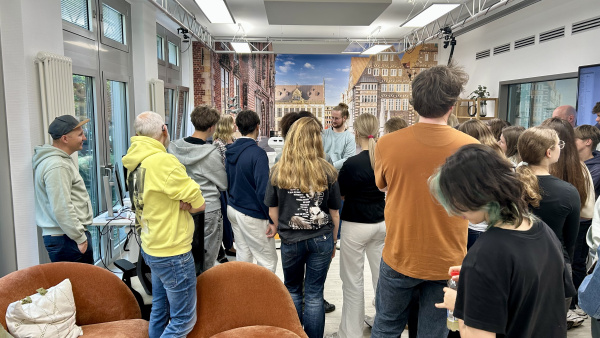
As part of a high school Erasmus+ science exchange program, we had the pleasure of hosting a group of highly motivated students from Germany and the Netherlands.
In advance, the students explored programming for intelligent household robots within our Virtual Research Building (VRB) environment — from core cognitive robotics concepts to hands-on, interactive tasks they could tackle themselves.
Michaela Kümpel delivered an opening talk to the high school students, followed by live robot demonstrations presented by Vanessa Hassouna and Jeroen Schäfer. The students also had the opportunity to speak with several of our PhD and Master students about robotics, artificial intelligence, and studying at the University of Bremen.
These discussions, combined with hands-on experiences, clearly demonstrate the important and inspiring role of practical learning for the next generation of computer scientists and engineers.
Learn more about the VRB and our educational resources here: https://vrb.ease-crc.org/education/
AI-Based Robotics in the Cloud with the Virtual Research Building (VRB) - Hands-on Workshop at AIM July 7-10, 2026
We will be present at the AIM 2026 in Genova, Italy with a hands-on workshop titled “AI-Based Robotics in the Cloud with the Virtual Research Building.”
In this tutorial, we introduce the Virtual Research Building (VRB) as a cloud-based platform for AI-driven robotics research and experimentation.
The workshop is explicitly hands-on: attendees are invited to bring their own laptops and actively try out the demonstrated concepts. We will cover:
- The core concepts behind the Virtual Research Building
- What virtual labs are and how they can be used to model, run, and analyze robotic experiments
- How to use and interact with existing virtual labs remotely
- How to edit existing labs or create new ones
- How to integrate your own lab setups and robot models into the lab
The goal is to give participants a concrete, practical understanding of how cloud-based robotics experimentation can be set up, customized, and extended. In addition to the hands-on tutorial, the session will include two invited talks:
- Dr. Michaela Kümpel (Uni Bremen):
- Cloud-based digital twins for AI-driven robotics: Key advantages and potential applications
- Prof. Uwe Aßmann (TU Dresden):
- The Test Infrastructure of the Smart Mobility Lab of TU Dresden as Part of the RIG Virtual Research Building
These talks provide context and concrete examples of how cloud-based digital twins and large-scale test infrastructures are integrated into the VRB ecosystem.
Technical requirements: All interaction with the VRB takes place directly in the browser, so no special software installation is required. To obtain and manage the provided example material, having git installed is recommended. For more convenient local development, building, and testing of labs, docker and docker compose may additionally be useful.
Workshop organizers: Dr. Mareike Picklum, Malte Huerkamp, Luca Krohm, Dr. Benjamin Alt, Andre Meixner, Dr. Jonas Kiemel, Prof. Dr. Alexander König Jointly organized by several RIG partners, this workshop highlights cutting-edge research in cloud-based robotics and showcases the Virtual Research Building (VRB) as an innovative infrastructure for AI-enabled robotics development, testing, and collaboration.
Important: Registrations for AIM 2026 are now open. Please refer to the registration page for details and instructions.
Early registration is recommended!
IJCAI-ECAI August 15 & 16, 2026: Hands-On Cognitive Robotics Tutorial with AICOR VRB
Alongside the 35th IJCAI International Joint Conferences on Artificial Intelligence Organization, taking place in Bremen in August 2026, Michael Beetz, Michaela Kümpel, and Vanessa Hassouna are organizing a two-day tutorial on “Knowledge-Driven Action Execution using a Virtual Research Environment” on the basis of the AICOR Virtual Research Building (VRB). Next to the robotics labs of the AICOR Institute for Artificial Intelligence (IAI), you get the chance to learn the basics of programming the entire cognitive robotics workflow, enabling a robot to perform the task of “bringing the milk to the table”.
This two-day tutorial introduces knowledge-driven approaches to robot action representation, reasoning, and execution through a mix of theory and hands-on exercises. Participants explore key elements of cognitive robotics, including scene understanding, semantic reasoning, and action execution in simulation.
They will design a virtual robot environment, perceive objects, and use semantic knowledge to perform tasks like “getting the milk from the fridge.” Interactive Jupyter Notebooks in a Docker setup ensure accessibility, while physics-based simulation enables experimentation with robot behavior. The tutorial provides a scalable framework for teaching cognitive robotics and knowledge-based AI systems.
We are looking forward to welcoming you for two exciting days of learning, experimentation, and innovation in cognitive robotics!
📍 Bremen, Germany
📅 August 15-16, 2026
🔗 https://2026.ijcai.org/registration/
Teaching
A detailed description of most courses can be found in the Online Module Handbook of the Department.
If you are looking for lectures from past semesters, take a look at our Lecture archive.
Besides lectures and projects, we also offer thesis assignments and jobs for student research assistants. If you are interested, you can find more information here.
Prof. Dr. h. c. Michael Beetz PhD
Head of Institute
Contact via
Andrea Cowley
assistant to Prof. Beetz
ai-office@cs.uni-bremen.de
Discover our VRB for innovative and interactive research

Memberships and associations:



Social Media: